

It’s a familiar theme at this point: healthcare costs are again expected to rise in 2026, with some projections suggesting a nearly double-digit rise in employer healthcare costs. There’s more pressure than ever for payers, employers, and benefits advisors to address healthcare costs and make sure that their chosen programs work. But how do you do that? How do you manage costs without reducing healthcare quality? How do you know the data you’re making health and wellness program decisions on is reliable?
Our 2026 healthcare trends webinar covered these topics. Experts from Truven’s Analytics, Research & Solutioning team offered deep dives into the latest on GLP-1s and the explosive growth of gene therapies. They also discussed a foundational approach employers and payers can use to evaluate and support the physical, mental, and financial health of their populations.
GLP-1 drug trends
The increasing utilization of GLP-1 medications has moved beyond a mere trend to become a dominant cost driver for payers and employers. The below graph shows MarketScan trends for patients per 1,000 and allowed per member per year (PMPY) spend for GLP-1 medications from 2013 to 2025. Along the x-axis is a timeline of FDA approvals.
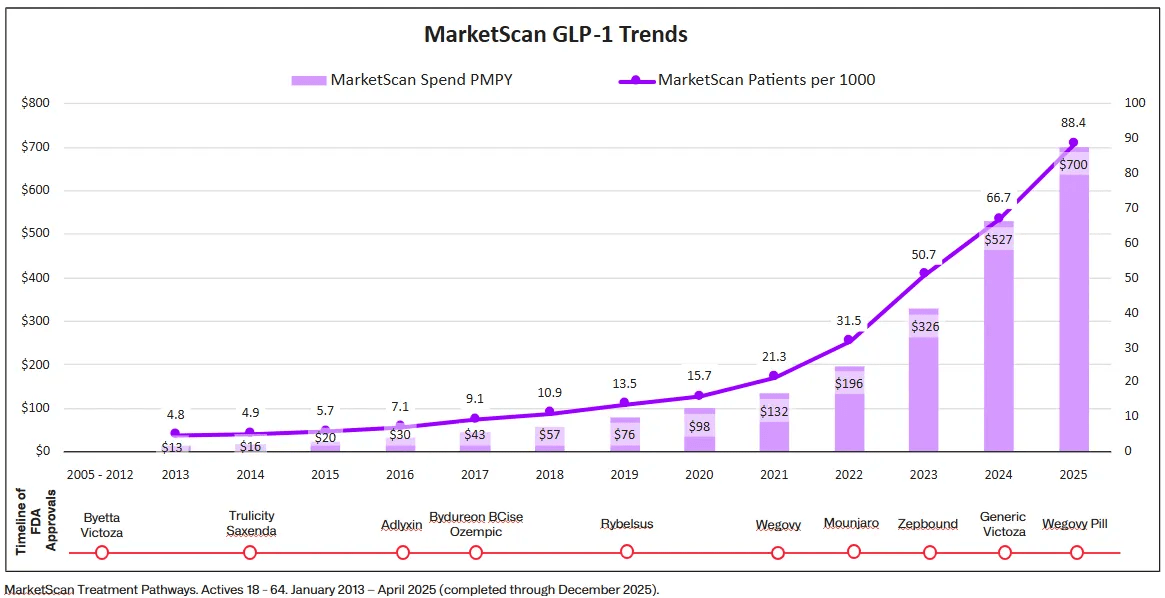
Utilization has skyrocketed from 4.8 patients per 1,000 in 2013 up to 88.4 per 1,000 in 2025. Likewise, allowed PMPY spend has followed suit, rising from $13 PMPY in 2013 to $700 PMPY in 2025.
This rise is due to GLP-1s becoming a standard of treatment for diabetes, only behind Metformin in utilization rates, and expanding into broader obesity and weight management treatment. This is especially true in the last year or two where it has really gained momentum.
Payers are left wondering how to approach this trend? Can adopting metabolic programs control costs while ensuring appropriate care? The success of these programs hinges on precision, with best practices dictating that coaching must aim for specific behavior changes rather than generic lifestyle advice.
Engagement goals must be clearly defined, and continuous monitoring is essential. Payers are finding that projecting impact and measuring outcomes requires specific data elements. It’s no longer sufficient to track aggregate spend; organizations must integrate program data into their data warehouses to track specific outcomes and Return on Investment (ROI).
Ambiguity in utilization is a major hurdle in managing GLP-1 spend. To combat this, organizations now require recorded diagnosis codes for prior authorizations. Requiring a diabetes diagnosis code for diabetes-indicated products and a BMI diagnosis (Z-code) for obesity-indicated products ensures that members are receiving the correct medication for their specific condition.
Furthermore, financial outcome analysis requires product-level rebate transparency. Without this granular view, it’s difficult to make informed formulary management decisions or set clear performance guarantees for point solutions.
Gene therapies
While GLP-1s dominate current discussions, gene therapies represent the next frontier of financial risk and clinical opportunity. Gene therapy, a form of precision medicine typically delivering genetic material via “viral vectors,” is transforming the treatment landscape for hemophilia, cancer, and rare neurological and eye diseases.
The economic implications are staggering. The gene therapy market is expected to grow at a Compound Annual Growth Rate (CAGR) of over 40% through 2030, reaching an estimated $48 billion annually. For payers, this trajectory signals a need to prepare for high-cost claims that, while infrequent, can be financially destabilizing.
Managing this spend requires a multifaceted approach. Coverage considerations must start with verifying patient appropriateness through the collection and transmission of relevant testing, radiology, and diagnoses.
To mitigate financial exposure, payers are exploring innovative funding models. Value-Based Care (VBC) and outcome-based payment models are gaining traction, allowing organizations to tie payments to actual clinical results. Additionally, reviewing Stop-Loss Insurance and Risk Sharing Agreements is crucial to determine how per-member pricing compares to relative risk.
Data plays a pivotal role here as well. Effective management requires recorded results from genetic testing for prior authorizations. Collecting care notes and EHR data helps fill clinical gaps in claims data, verifying that these high-cost medications are being used appropriately.
Finding balance
The webinar also discussed how the definition of member health is expanding. There is a shift from viewing wellness solely through a physical lens to a more holistic approach, which is that wellness = physical + mental + financial health.
Mental health remains a critical component of this equation. National Alliance on Mental Illness (NAMI) statistics reveal that 23.4% of U.S. adults experienced mental illness recently, representing more than 1 in 5 adults. Additionally in the U.S., serious mental illness causes $193.2 billion in lost earnings each year.
The supply-demand gap further complicates this issue, with over 120 million people living in designated Mental Health Professional Shortage Areas. For payers, this necessitates integrating data from mental health partners to better understand population needs and evaluate the effectiveness of point solutions.
The common thread across all these trends is the reliance on advanced analytics and seamless data integration. The webinar highlighted that we are moving away from a model where the member is solely accountable for their care, toward Accountable Care Organization (ACO) arrangements where members partner with providers.
One of the most effective strategies for controlling costs without compromising quality is site of care optimization. By leveraging site of care analytics, payers can understand the cost and utilization of services across different settings. This insight allows for the assessment of potential savings by steering members to preferred providers in lower-cost, clinically appropriate settings.
This strategy offers significant business value, including lowered healthcare costs and member liability, improved patient convenience, and a decreased risk of hospital-acquired infections.
Finally, financial health is the often-overlooked third pillar. Financial stressors, such as 401(k) loans and Health Savings Account (HSA) balances, directly impact a member’s ability to adhere to care plans and maintain physical health. By ingesting diverse financial data types, payers can analyze the impact of financial security on clinical adherence. This holistic view allows for the identification of members who may be at risk not just physically, but financially, allowing for earlier and more effective interventions.
Truven uses an “Opportunity Score” to help our clients understand these risk factors in their population and act. Opportunity score ranks individuals from 1 to 100 based on their potential for intervention. It consolidates multiple risk factors—gaps in care, event risk, financial risk, and comorbidities—into a single, actionable score.
This allows clients to identify:
- Who is at risk for significant cost increases
- Why a person has a high risk
- When the cost is expected to occur
By using predictive cost modeling, organizations can proactively manage high-risk and rising-risk populations.
Key takeaways: Building success in 2026 and beyond
This year is set to become one of the costliest years in the past decade – how do you build a successful future? You need three factors:
Data - Data strategy must evolve, emphasizing both the integration of new data sources and the effective use of healthcare benchmarking to guide decisions and control costs.
Analytics - Analytics must be both advanced and accurate – allowing for flexibility and adjustments, but built on a bedrock of expertise.
Partnerships - Industry experts and strong vendor partnerships are critical for the success of employers and payers – knowing how to influence trends and collectively work together towards a common goal.
Want to learn more? Watch our webinar replay.
Related Articles

3 Takeaways from the 2025 Truven Health Insights Summit
Last year I wrote about bringing Truven back to its roots, and one important part of...

From data to decisions: How Truven is shaping the future of healthcare
2024 has been a landmark year for Truven, filled with significant milestones and...

Data & Analytics as a Service (DAaaS) in healthcare: Speed, scale, and sustainable insight
The story at a glance: