What you need to know
- Merge customers are navigating a complex technology landscape: adopting AI responsibly, modernizing their infrastructure for cloud and hybrid operations, improving speed and usability for clinicians, and maintaining security and data integrity at scale.
- Merge PACS is designed to support clinical and technical teams achieve their goals on this front, while keeping imaging workflows reliable and efficient for delivering patient care.
- This piece outlines what imaging organizations frequently ask for, and how Merge PACS addresses those needs through continued innovation and development, thoughtful design, and flexible deployment approaches, to deliver measurable value for Merge users.
- Reach out to talk directly with us about Merge PACS can support your enterprise imaging goals.
1. AI integration and readiness
Providers want the flexibility to adopt AI at their own pace, without locking into a single algorithm provider or disrupting daily reading workflows. Merge PACS is “AI ready” with integration support from a range of AI vendors, such as Aidoc. Merge PACS makes those results available where physicians need them: in the worklist and in the viewer.
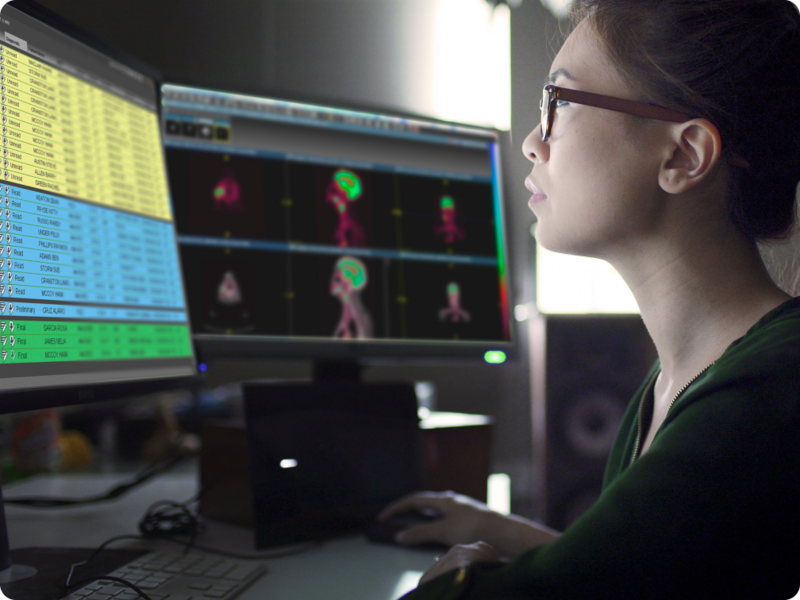
Merge PACS receives AI outputs (including secondary capture content) and incorporates them into the reading experience. The worklist indicates AI availability or status so users can quickly see whether a study has been processed. From there, AI results can be launched directly in the viewer, helping teams keep attention on interpretation rather than on hunting for results across windows and systems.
For breast imaging workflows, Merge PACS supports structured AI content such as Computer-Aided Diagnosis Structured Reports (CAD-SR) used in mammography environments. Integrations include vendor solutions from Volpara, Therapixel, Hologic and iCAD. Because structured outputs can vary by vendor implementation, Merge’s platform approach focuses on practical interoperability — supporting what is standard and accommodating vendor-specific differences when additional handling is required.
Merge PACS is built with integration in mind and continues to be enhanced as new AI use cases emerge, ensuring that as AI evolves, customers don’t find their PACS has become a bottleneck, and instead can rely on consistent clinical workflows and governance.
2. Cloud deployment, and hybrid solutions
Many imaging organizations are moving toward cloud strategies, but not at the same speed. Some want a full cloud deployment; others need a hybrid model to preserve existing investments and stage migrations. Merge PACS supports any approach so that customers may align their deployment to their cloud journey.
In addition to operating as a standalone PACS in the cloud, Merge PACS can also be deployed as part of a broader imaging portfolio to support enterprise imaging needs. This flexibility supports common customer scenarios — such as maintaining certain components on premises while enabling cloud-based reading, scaling, or disaster recovery patterns where appropriate.
3. Performance and study retrieval speed
Speed matters to physicians who are reading high volumes across multiple modalities and locations. They ask for fast study retrieval, predictable loading behavior, and performance that holds up as volume grows. Merge PACS addresses performance as an ongoing discipline. Each release is validated against benchmarks to ensure retrieval and viewing performance are consistent – and then improve over time.
Merge PACS is continuously updated with practical improvements that customers feel in their day-to-day. In recent releases, effective cache management and tuning has improved responsiveness for users moving between studies. Because real-world performance depends on many factors (network, storage, study size, and workflow patterns), Merge’s focus is on dependable outcomes and continuous improvement rather than oversimplified “one number” speed claims.
4. Viewer capabilities and usability enhancements
Merge customers prioritize usability: fewer clicks, faster navigation, and tools that support confident interpretation across modalities. Each release of Merge PACS evolves the viewing experience by adding and refining tools that support daily reads and specialty workflows, for efficiency and consistency.
Recent usability-oriented improvements include dynamic worklist refresh, expanded ROI (region of interest) tooling, spine labeling revision, and refinements that help reduce friction during interpretation. The goal is simple: support radiologists with a viewer that feels responsive and clinically intuitive, while enabling standardization across an enterprise.
Deployment models also influence the viewing experience. In cloud configurations, Merge PACS supports a robust client-based viewer experience. For organizations that require a browser-based, zero-footprint approach in certain scenarios, those needs can be addressed through complementary portfolio options (for example Merge Universal Viewer) — allowing customers to match the viewing experience to the use case (diagnostic reading, enterprise access, referring physician review) without forcing a one-size-fits-all model.
5. Customization and workflow flexibility
Since every imaging department operates differently, customers often need the ability to tailor worklists, assignments, and routing rules to fit subspecialty reads, coverage models, and service-line priorities. Merge PACS has longstanding capabilities for flexible workflow configuration, supporting multi-parallel workflows and configurable worklists that align with diverse clinical operations.
Features such as batch processing also help administrators and operational users perform common bulk actions (for example, assignment, reservation, or status updates) to keep work moving smoothly, particularly in high-volume environments.
6. Data, integrity, and synchronization
Imaging leaders need confidence that the “right images and the right data” will be available at the right time — especially as organizations scale across facilities and adopt enterprise imaging strategies. Merge PACS supports various operational models, including both standalone deployments and integrated approaches.
In integrated enterprise imaging environments, image lifecycle management is most effectively centralized in an archive layer (such as Merge VNA) rather than managed independently by each consuming system. Centralizing the rules for retention, deletion, and lifecycle management helps reduce inconsistency and avoids synchronization issues caused by policies that are applied in multiple places.
Customers also benefit from setting realistic expectations during transitions from standalone to integrated modes. As data is reconciled and historical exceptions are resolved, organizations may temporarily need a controlled process for handling a small subset of exams that require manual review. Merge PACS readily supports these operational realities. Successful adoption typically pairs technology with strong change management. helping teams understand new workflows, toolsets, and responsibilities across the integrated ecosystem.
7. Mammography and tomosynthesis support
Breast imaging requires specialized workflows and a high level of confidence in both image handling and reader tools. Merge continues to invest in Merge PACS’ mammography capabilities, including support for tomosynthesis, and many other enhancements that have been delivered over multiple releases and adopted by customers in production environments.
These breast imaging enhancements also align with broader priorities like AI integration and structured results support. By enabling clinically meaningful outputs to appear in the worklist and viewer, Merge PACS empowers breast imaging teams to incorporate advanced tools while maintaining a cohesive, efficient reading experience.
8. Security and technology updates
Security and currency are foundational requirements for all Merge imaging solutions, including Merge PACS. All of our solutions are regularly updated to align with evolving security standards, infrastructure expectations, and vendor support lifecycles. Merge PACS emphasizes ongoing maintenance and modernization so customers can keep pace with security patches and technology updates without disruptive reinvention.
Keeping up to date with each new Merge PACS release reduces risk and supports resilience for our customers. Regular updates help protect patient data, sustain compliance posture, and ensure the imaging environment remains compatible with broader IT strategies. This “keep the foundation strong” approach also enables faster adoption of new clinical capabilities because the underlying platform remains modern and supportable.
Bringing it together: the enterprise platform approach with Merge PACS
For Merge customers, these many requirements usually show up more than one at a time. AI strategy influences workflow, cloud strategy influences performance expectations, and enterprise imaging strategy raises the bar for data integrity and security. Merge PACS is built to address these needs in combination — supporting flexible deployment models, practical AI integration, ongoing viewer and workflow enhancements, and a disciplined approach to performance and platform currency.
Most importantly, Merge remains committed to customer driven innovation and collaborative transformation. One of our guiding principles is helping organizations standardize where it matters while preserving flexibility where it counts. If your team is planning a cloud or hybrid path, evaluating AI enablement, or looking to streamline reading and operational workflows, Merge is ready to help you map the course. If your goal is a clear path to modernization, we can help your organization adopt new capabilities confidently, keep clinicians productive, and build an imaging foundation that can evolve alongside the demands of patient care.