What you need to know
- Healthcare organizations seek faster, more reliable, and better-connected imaging experiences for clinicians and patients.
- Many of the most common enterprise imaging requirements sound straightforward —advanced clinical tools, seamless EMR / EHR access, strong governance, and reliable performance. But delivering them at scale can be complex..
- Merge Enterprise Imaging Solutions —Merge Universal Viewer (MUV) and Merge Vendor Neutral Archive (MVNA) —are designed to help organizations meet these expectations pragmatically.
- Let us know if you’d like to talk more about how these solutions can deliver on your imaging requirements – or request a demo to see them in action.
Merge Universal Viewer provides a zero-footprint, vendor-neutral viewing and diagnostic experience across systems and locations. Merge VNA provides durable, standards-based imaging data management, policy control, and enterprise-scale performance. Together they support a “federate before you consolidate” approach: connect and unify data and access first, then migrate and optimize on achievable timelines.
Read on for a refresh on how Merge Enterprise Imaging aligns to common customer requirements today — from what imaging organizations frequently ask, to how Merge addresses those needs and delivers measurable value through continued innovation and development, thoughtful design, and flexible deployment approaches.
1. Advanced diagnostic tools clinicians can use every day
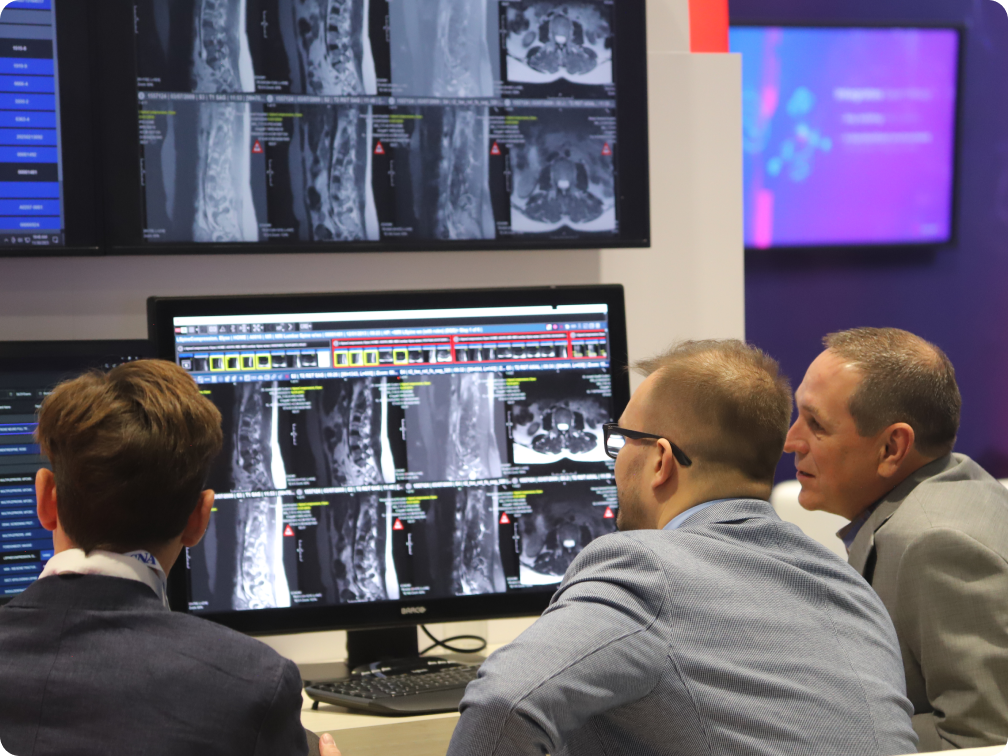
Enterprise imaging programs need a viewer that supports real clinical decision-making, not just standard image display. MUV includes a deep set of diagnostic and image processing capabilities that cover everyday interpretation workflows as well as more advanced use cases.
Core functionality includes familiar reading tools such as zoom, pan, window/level, playback controls, series linking and synchronization, and common measurements (line, angle, and region-of-interest). For cross-sectional imaging, MUV also supports advanced visualization, including multi-planar reconstruction (MPR), maximum intensity projection (MIP), and color volume rendering — capabilities that help clinicians extract more value from complex studies without switching contexts.
Recent releases continue to expand this toolset. Enhancements include echocardiology-focused ultrasound tools and cardiology measurements such as slope time, velocity, time integral, area, volume, and ejection fraction. AI-enabled workflows help organizations incorporate results from medical device programs — such as lung nodule screening and lesion tracking, where MUV could potentially help reduce radiologist reading time by an average of 23% — while keeping the user experience within the same viewer clinicians already use.
2. Integration with EMRs, PACS, VNAs, and portals - without vendor constraints
When imaging spans multiple departments and sites, integration becomes as important as the viewer itself. MUV is built as a vendor-neutral viewer that connects to a wide range of third-party systems —including EMRs, patient portals, PACS, and VNAs — using standards-based interoperability (including DICOM).
In practice, this means imaging teams can unify access even when data remains distributed. MUV can connect to multiple data sources at the same time and present a single, patient-centric view across disparate systems. It also supports multiple launch and URL patterns to align with different EMR workflows — regardless of whether access is initiated by radiology, referring providers, specialists, or even patient-facing experiences.
This flexible integration model helps reduce “rip and replace” pressure. Organizations can modernize user experience and capabilities by moving users to a current, enterprise-grade viewer, while continuing to work with existing upstream and downstream systems as needed.
3. Annotation editing, correction, and quality control that supports governance
Enterprise imaging is a team sport that requires reliable tools for annotation, correction, and quality control. MUV supports core annotation workflows that help clinicians communicate findings, standardize interpretation, and maintain study integrity over time.
In newer versions, quality control capabilities are further strengthened through a dedicated QC module. This supports common operational needs such as linking studies to orders, as well as merging and splitting studies and series when corrections are required. For clinical communication and teaching workflows, MUV also supports key image creation, helping teams elevate the most important frames or views for downstream review.
4. A modern user experience that scales across specialties
Usability and user experience are critical success factors as enterprise imaging expands beyond radiology and cardiology. Clinicians want a consistent experience across the enterprise, regardless of their department or site, and they want tools that reflect the way their specialty works. With MUV, Merge continues to invest in user experience improvements that help broaden adoption across “-ologies” and care settings.
Recent enhancements align the interface with expanding capabilities — supporting workflows such as QC, lesion tracking, lung nodule programs, and echocardiology measurement. The result is a workflow experience that can be configured to feel intuitive for different user groups while still maintaining a single enterprise platform for viewing and diagnostic work.
5. Policy-driven archiving with automation and logical segmentation
On the content management side, Merge VNA is designed for scalable policy control — helping imaging teams reduce manual effort while improving consistency. Administrative rule setup is supported through guided, wizard-based configuration that makes it easier to create, simulate, and test behaviors before changes are put into production.
This policy framework supports operational capabilities such as prefetching, “morphing” for data normalization, and policy-based deletions. Just as importantly, Merge VNA supports logical segmentation through tagging rather than physically separating storage by department or facility. That approach helps imaging organizations maintain clean governance boundaries while still benefiting from efficient, unified storage management at enterprise scale.
6. Actionable reporting and analytics for operations and performance
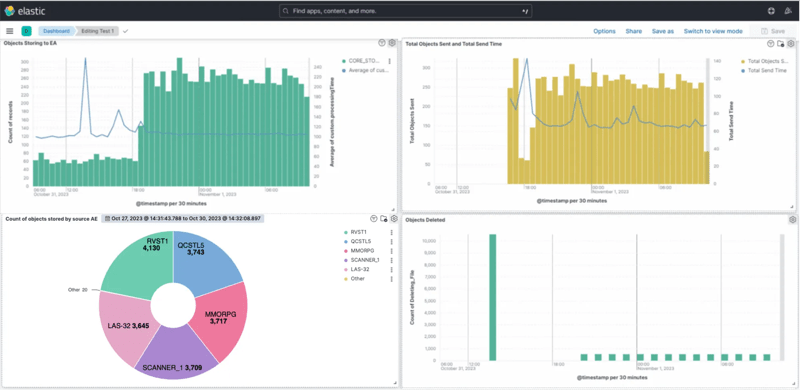
Enterprise imaging leaders increasingly expect the archive to provide visibility, not just storage. Merge VNA provides strong reporting and analytics so teams can answer practical questions about utilization, workflow effectiveness, and system health.
Enhancements include improved analytics and rebuilt logging designed to surface meaningful performance and operational metrics in a consumable way. These metrics can be integrated into visualization platforms — either customer-selected tools or built-in options such as Kibana — so stakeholders across IT and imaging operations can monitor trends, identify bottlenecks, and support continuous improvement.
7. Reliable retrieval, a modern admin experience, and strong DICOM discipline
Archiving is only valuable if data is consistently retrievable, configurable, and standards-compliant. Merge VNA focuses on retrieval speed and scalability, with planned improvements aimed at strengthening performance as client environments grow in size and complexity.
At the same time, modernization efforts are improving the administrator experience. Configuration options that historically required command-line work are being moved into the user interface, reducing dependency on specialized Linux expertise and making it easier for teams to manage day-to-day operations.
DICOM compliance is a top requirement. When incoming images contain tag violations, morphing rules can correct issues automatically, while non-compliant objects can be placed into an exceptions area for manual review. Compliance rules can also be tuned for specific tag types, helping organizations strike the right balance between strict standardization, practical interoperability, and automation.
8. Cloud-ready performance, efficient migrations, and dependable upgrades
Merge is committed to meeting customers where they are on their cloud journeys – whether that’s in the cloud or in a hybrid configuration. As part of that commitment, we continue to invest in Merge VNA’s cloud performance, and introducing cloud-focused capabilities that include efforts to make the platform more cloud-native over time.
Cloud migrations are another common pain point for healthcare providers, especially when cost and downtime risk are high. Using in-house migration tools and services can reduce dependency on third parties while improving predictability for large data moves. And once systems are live, operational confidence matters: ongoing investments in testing and a responsive patch process help support stable upgrades and fast resolution when issues arise.
The takeaway: Federate before you consolidate for a practical enterprise imaging strategy
One of the most effective ways to reduce risk in enterprise imaging is to separate “access” from “migration.” Rather than waiting for every archive and PACS migration to complete before clinicians see value, organizations can start by federating access to imaging data across systems, prior to integration or consolidation.
With MUV, teams can connect to disparate sources and present a unified patient imaging story quickly. This approach is especially valuable after mergers and acquisitions when new facilities need to be brought into a common clinical experience in a lightweight way. Over time, that same organization can consolidate content into Merge VNA on a planned schedule, aligning migrations to operational readiness, budget cycles, and infrastructure strategy — without sacrificing near-term clinical access.
Bottom line
Merge Universal Viewer and Merge VNA are built to address the requirements enterprise imaging leaders hear most often — advanced diagnostic capability, broad image access and sharing, standards-based interoperability, strong governance tools, operational analytics, flexible image management, and a steady path to cloud readiness. The combined approach helps organizations improve imaging access, while keeping long-term consolidation and modernization firmly in mind.