Skip to content
    micromedex
    Quarterly thought leadership
    from our subject matter experts

    Micromedex Spotlight on AI in Healthcare

    Issue One | 2026

    ILLO-Micromedex-Email-05-336x336
    Table of Contents
    Share via

    In this issue

    Each quarter, Micromedex publishes insights on healthcare trends from our subject matter experts.

    In this edition, our experts discuss AI adoption in clinical practice, from a variety of healthcare viewpoints:

    • AI in nursing
    • AI across clinical workflows
    • AI in pharmacy practice
    • AI in toxicology

    And we provide practical insights into AI technology:

    • Conversational AI in Healthcare
    • The benefits of AI in CDS
    • Practical AI evaluation strategies

    Use the table of contents to jump to the area that interests you most.

    AI across clinical workflows

    Angela-Angerson
    Angela Anderson, MSN, RN-BC
    Senior Director of Content Optimization & Innovation, Micromedex,

    Artificial intelligence (AI) is transforming workflows across industries, revolutionizing the way we work, solve problems, and innovate. In healthcare, AI tools continue to gain traction. Healthcare providers are finding innovative opportunities for AI-systems to optimize clinical workflows, enhance precision, promote efficiency, and improve patient outcomes.

    By automating repetitive tasks, expediting decision-making, and streamlining complex processes, AI-powered tools can optimize clinical workflows, and empower healthcare providers to focus more on patient care. 

    Enhancing clinical workflows for medication safety

    Medication errors remain one of the most significant challenges in patient safety—but the right tools can make a difference. Medical evidence continues to grow at an exponential pace. It’s become increasingly difficult for clinicians to quickly find the medication insights they need to make safe decisions for patients. Leveraging clinical decision support systems to provide the latest curated evidence, sourced from the world’s medical literature, ensures healthcare professionals will find accurate answers to support their decisions, even in complex patient care scenarios.

    By pairing AI technology with the large content repositories underlying clinical decision support systems, critical insights can be delivered even faster, in a way that better supports the clinical workflow to accelerate decision-making. Applying AI technologies like large language models (LLMs) and machine learning to the search functionality within these trusted, high-quality datasets based on curated evidence is a game-changer. Especially in terms of boosting the “findability” of specific information needed to support medication safety.

    Many of today’s tools offer generative AI driven, summarized answers that can eliminate multiple clicks, scrolls and reduce the cognitive burden of having to synthesize information from multiple documents. For example, a clinician looking for alternatives to a therapy that is not working or to discern which medication is best suited for a patient with multiple comorbid conditions.

    Considerations for safe AI-powered clinical decision support solutions

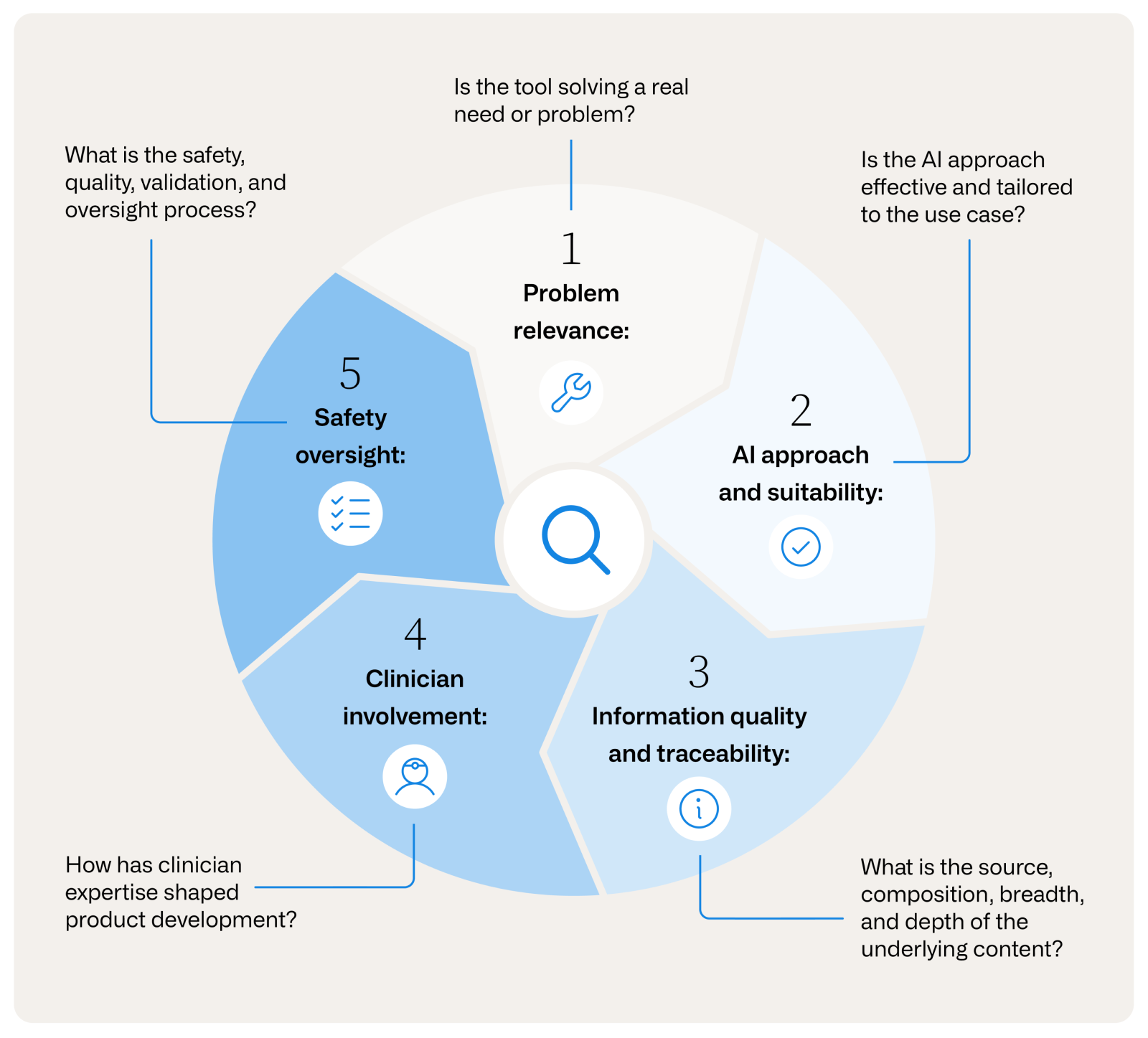
    Not all AI solutions are created equal. Close attention to how generative AI is leveraged, the underlying knowledge source and approach to clinical validation must be carefully considered when a tool will be used to inform patient care. Clinicians should be part of the development and continuous quality monitoring process.

    Other AI applications in healthcare workflows

    New use cases for AI continue to evolve, automating and simplifying tasks with a goal of freeing up clinician time for patient care. Click to read the full blog for 6 more examples of AI in clinical workflows, and what this means for the future of artificial intelligence in healthcare delivery.

    Read the full blog

    IMG-Micromedex-18-3840x2160

    Unlock Full Content

    ×

    Please complete this form to access the complete quarterly spotlight content.