How is AI used in poison centers? What benefits does it bring to clinical toxicology and what are the applications in the broader toxicology space? Discover expert insights from the intersection of AI and toxicology.

For those working in clinical toxicology in poison centers or emergency medicine, every second counts. Fast access to accurate information is critical to decision-making in these high-pressure environments. This is where artificial intelligence (AI) can add value.
Advancements in evidence-based clinical decision support systems to leverage AI technology can help reduce cognitive load by serving up real-time, relevant and context-specific answers to toxicology queries, based on trusted, cited clinical information. Let’s take a look at the real-world challenges in clinical toxicology, and the potential impact of AI.
Toxic exposures: A global public health challenge
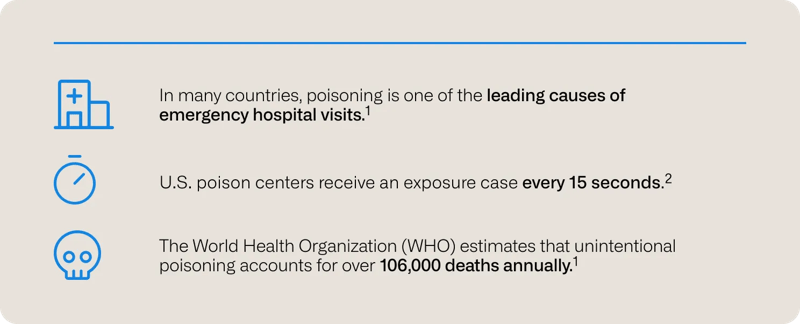
Toxic exposures represent a significant global public health challenge, affecting millions of lives each year. In many countries, poisoning is one of the leading causes of emergency hospital visits.1 For example, U.S. poison centers receive an exposure case every 15 seconds,2 and The World Health Organization (WHO) estimates that unintentional poisoning accounts for over 106,000 deaths annually.1
The vital role of toxicology experts in poisoning emergencies
With an estimated 40,000 to 60,000 industrial chemicals and environmental toxins in circulation globally,1 in addition to pharmaceuticals and drugs of abuse, healthcare professionals can’t be expected to know the toxicity of every substance. This highlights the critical need for specialized knowledge and the vital role of clinical toxicologists for appropriate diagnosis and treatment in time-dependent emergencies. These specialists help bridge the knowledge gap, but access to trusted evidence to support their decisions is key. Toxicological evidence is often scattered across niche journals, many of which are published behind paywalls.

Tools for fast, evidence-based decisions
When every second counts, there’s no time to search through medical literature and journals for relevant toxicology evidence for the case at hand. Clinical toxicologists rely on specialized, evidence-based databases with expertly curated content. The highest quality tools will include clinical and adverse effects, range of toxicity, patient disposition criteria, and detailed treatment guidelines. These resources allow them to manage incidents and treat patients with a wide range of toxic exposures effectively.
Now, with advancements in machine learning and large language models, AI-powered search can be applied to trusted toxicology databases, giving specialists another way to get crucial, time-sensitive answers. Let’s take a look at the value this can bring to clinical toxicology.
The role of AI in toxicology databases
- Speed to answer: Information in toxicology databases is often detailed and extensive. Finding the right answer for a specific case can take time due to the vast amount of data available. The use of AI-powered search enhances the ability to quickly locate specific, relevant information.
- Reduced cognitive load: Applying natural language processing to the search functionality within toxicology databases allows users to ask questions in their own words, without needing to consider how the information is organized. This is especially valuable in specialized fields like toxicology, where nuanced searches are frequent. These deep learning AI models simplify the search process, significantly reducing the mental effort required by users to reframe their queries in a way the system can understand.
- Faster decision-making: By minimizing the effort spent searching for information, AI-powered tools can enhance toxicology workflow efficiency. This enables users in poison centers and emergency medicine to focus on informed decision-making, and managing urgent cases and toxicity assessments more quickly.
- Accuracy and traceability: Advanced toxicology databases that provide full citations and hyperlinks to the supporting evidence behind AI-driven answers make it easy for users to trace data sources. This streamlines fact-checking and supports confident, evidence-based decisions.
The value of AI for different user groups in toxicology
AI-powered tools can enhance workflows and decision-making for a variety of users in clinical toxicology, from experts to newcomers, as well as toxicology-adjacent professionals.
- For seasoned toxicology specialists: Even the most experienced clinical toxicologists can benefit from AI in their workflow. For those who already know where to find toxicology information, AI-powered search serves as a powerful assistant, helping to process queries fast and pinpoint nuanced answers with precision.
Case study: For example, an experienced toxicology consultant on call from a regional poison center needs accurate dosing information for a rare antidote in a time-sensitive situation. In a timed trial executed using the Micromedex AI-powered search to access evidence-based toxicology information in Micromedex, AI performed faster than the manual search of the experienced toxicology consultant when identifying the correct dose of penicillin G for treating amanita mushroom toxicity.
- For early career toxicology specialists: For those earlier in their career, and perhaps less familiar with the location of specific evidence detail within an expansive toxicology database, AI can be an invaluable learning tool. By using AI-powered search within a trusted resource, not only can they find the information they need quickly, but if it also cites evidence-based sources, it is encouraging users to explore deeper content and learn as they work, expanding their knowledge base
For example, a toxicologist-in-training needs to find information on toxic effects and treatment recommendations for a snakebite. The user can quickly search this question in Micromedex using AI-powered search and have the answers served to them, while also providing links to more detailed content. This can help build confidence and competence in their decision-making.
- For users not specializing in toxicology: AI can also provide critical support for users outside of toxicology specialties, such as emergency medicine doctors, ICU staff, or general practitioners who may encounter toxicology-related cases occasionally in their clinical practice. In these high-pressure environments, quick and accurate answers are essential.
For example, an ICU nurse wants to double check the dosing of N-acetylcysteine for acetaminophen toxicity. The AI-powered search in Micromedex can quickly deliver the answer to the nurse, while also providing a hyperlink directly to the drug information.
Data integrity is the backbone for reliable AI in clinical toxicology
The effectiveness of AI tools in clinical toxicology depends entirely on the quality of the data the AI models have access to. For AI to be a reliable tool for accessing information on drug toxicity or poisoning and its effect on human health, it must be built on high-quality, evidence-based, and meticulously curated clinical content.
General purpose AI systems like ChatGPT have limitations in clinical toxicology because they pull from vast amounts of open-access internet data, rather than curating content from evidence-based sources. This means they can sometimes provide inaccurate or incomplete information. For example, a 2024 study compared responses from AI systems like ChatGPT and clinical toxicologists to questions about poisoning. 15.8% of the observers considered the AI generated texts to contain major errors or omissions, and 3.3% rated them as unacceptable.3
This is why reliable, toxicology-specific databases like POISINDEX that carefully curate evidence from the world’s medical literature from PubMed and beyond, are essential as foundational sources for AI tools to draw accurate and current information from.
What are the broader potential applications of AI in toxicology?
Here are some of the current and future directions for AI in the broader field of toxicology.
- Administrative efficiency: Machine learning algorithms could be used to summarize patient charts and streamline follow-up processes for poison centers. This use of AI would free up specialists to focus on critical cases.
- Enhanced triage systems: AI-driven initiatives could enhance the triage process by offering AI-assisted data-driven toxicity risk assessment calculations. For example, AI could be used for rapid calculations of toxicity risk in pediatric exposures, based on age of child and amount of toxic product consumed, supporting efficient triage decisions.
- Optimized treatment protocols and therapeutic interventions: For complex medical toxicology cases, AI could be used to suggest additional supportive therapies in addition to the antidote. Using a machine learning approach to pull related therapeutic interventions in response to a toxin prompt could help build more comprehensive treatment plans.
- Streamlined data analysis and research: The deep learning capabilities of AI are ideal for performing statistical analysis on big data, providing the efficiency and scale required for high-throughput research. Large datasets are common in toxicology research, so AI could leverage deep neural networks to help accelerate pattern recognition in areas such as computational toxicology, or toxicity prediction for chemicals and chemical structures.
- Public health surveillance: AI technologies could be used to enhance early warning systems to help protect public health. By analyzing various data sources and poisoning metrics, machine learning algorithms could identify emerging chemical toxicity risks and flag public health trends, using predictive models to enable proactive intervention.
Will AI replace toxicologists?
Empowering, not replacing: AI as a partner to experts
While AI tools can use machine learning models like neural networks to help clinical toxicologists access and process information in a more convenient way, they cannot replicate the nuanced judgment of trained professionals.
Human expertise is needed, particularly when it comes to ethical concerns like the “black box” problem. This occurs when advanced AI algorithms operate without transparency, making their decision-making process difficult to understand. This lack of transparency makes it difficult to verify results and therefore unethical to act on AI-driven results in critical emergency situations where clear rationale is needed.
In a high-stakes field like toxicology, it’s critical for specialists to execute rigorous validation of AI models to ensure their outputs are accurate and reliable. Continuous monitoring and refinement of these models by toxicologists is essential to mitigate risks and ensure their effectiveness.
The future of toxicology lies in the responsible collaboration between AI and human experts, ensuring every decision is both informed and ethically sound.
Conclusion: A smarter future for toxicology
The role of artificial intelligence in clinical toxicology isn’t to replace human expertise but to enhance and support it. In time-sensitive situations where every second matters, AI-powered tools provide a notable advantage. They can help professionals find critical information fast, reduce cognitive load, optimize the workflow and streamline decision-making.
As we’ve seen, the true power of these AI tools lies in the quality of their data. When built upon a foundation of reliable, evidence-based toxicology content, and critically validated by experts, AI becomes a helpful partner. This collaboration between intelligent technology and human expertise is key.
I encourage you to explore how AI can be applied in your own practice and how to contribute to its responsible evolution.
Related Articles

Conversational AI in healthcare: Innovation in action
How we search for information in healthcare has come a long way. As artificial...
AI in clinical decision support: A game changer for healthcare?
Can artificial intelligence redefine clinical decision-making, driving operational...

Revolutionizing healthcare: The power of artificial intelligence in clinical workflows
Artificial intelligence (AI) is transforming workflows across industries,...