Free AI tools are convenient, but when it comes to clinical care, speed alone falls short. Clinical decision-making requires safer-by-default systems.


We all want to work smarter and faster, and there’s no shortage of free tools that leverage artificial intelligence (AI) to boost efficiency in the way we work. These general-purpose tools are maturing fast, even for many use cases in healthcare environments. But let’s be clear; when free AI tools are used as a crutch for clinical decision-making, the true costs of “free” become apparent.
In high-stakes clinical care, trust, transparency, and accountability must outrank convenience and zero-cost access. The reality is simple: technology can carry hidden liabilities, and the stakes in clinical care leave no room for risk.
Convenience does not equal clinical rigor
The convenience of free large language models (LLMs) is clear, particularly with mounting demands at the point-of-care on already stretched health systems.
While institutions debate policy and governance for organizational implementation of AI, clinicians are already adopting a rapidly expanding array of free AI tools as part of their daily work. The American Medical Association reports physician awareness and use of AI increased to 81% in 2026.1
The complexity of direct patient care demands answers, and free AI tools are easily accessible and provide answers fast. In many scenarios, these tools act as a handy sidekick; helping with workflow productivity, drafting non-clinical administrative emails, or summarizing policy documents for faster consumption.
But does speed suffice when patient care decisions are in play?
There’s no doubt that technology can create efficiencies, but speed means nothing if the system lacks rigorous clinical vetting. In fact, a 2026 report found that 71% of physicians cite accuracy and reliability as their top concern about AI tools.2
There’s no doubt that technology can create efficiencies, but speed means nothing if the system lacks rigorous clinical vetting.
Patient safety is non-negotiable
In a setting where decisions drive patient outcomes, the real goal is not just helping clinicians work faster at a lower cost, but designing systems that are safer by default.
Clinical care relies on trust and precision. Free AI tools may offer convenience, but they are often not purpose-built for clinical use or clinically validated for patient safety.
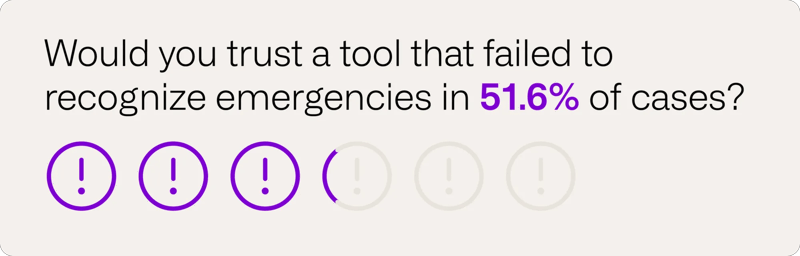
Safety oversight is critical. Every development stage should include validation to reduce risk and improve accuracy. Ongoing automated and clinician-led assessments help maintain quality as systems evolve. Free AI tools do not guarantee this. A recent independent evaluation of a consumer-facing free AI tool revealed it failed to recognize medical emergencies in 51.6% of cases.3 Furthermore, a preprint pilot study available prior to peer review found that a free AI tool achieved accuracy rates of only 34-41% for queries on complex subspecialty questions as adjudicated by four evaluators.4
Across pharmacy, nursing, radiology, and other clinical disciplines, patient care is a team effort. When team members use different free AI tools, inconsistency creeps in. Without a consistent, curated knowledge base, responses vary, increasing risk and potentially delaying care.
The most effective systems are built for both efficiency and safety.
Evidence matters
When it comes to clinical answers, the evidence base is the foundation for credibility. Clinicians need AI tools that have access to the necessary depth and breadth of source information to fully interpret the evidence correctly.
General-purpose tools that rely on medical study abstracts can miss crucial details or lack coverage of a patient population. Without a curated and controlled evidence base, responses to the same question can be inconsistent. A 2026 study of commonly used LLMs showed internal consistency as low as 0.60, with some models often disagreeing with themselves, changing recommendations even when presented with identical prompts.5
The pace of medical research is rapid, and it’s often unknown how frequently free tools update their evidence corpora, creating gaps that could influence treatment decisions.
A 2026 study evaluated the sources of information that general-purpose AI tools rely on when producing medical information, and found wide variability in their ability to cite strong evidence for surgery-related queries. It noted considerable concerns among widely accessible chatbots, stating that “reliance on lower-quality sources risk the dissemination of inaccurate or misleading medical information”.6
“Reliance on lower-quality sources risk the dissemination of inaccurate or misleading medical information”
- 2026 study published by Royal College of Surgeons of England6
What’s more, critical assessment of evidence quality can be a challenge for these tools. Without clinical experts curating the knowledge base from source evidence, these models miss clinical nuance and practical experience. This can lead to incorrect assumptions and misunderstandings.
Trust demands transparency
Free AI tools are maturing in their ability to quickly surface relevant information, but the bar for clinical decision support is higher than “usually right.” Clinicians need explainable reasoning and consistent, clearly cited sources. Transparency is not optional: answers from “black box” models create hidden risk.
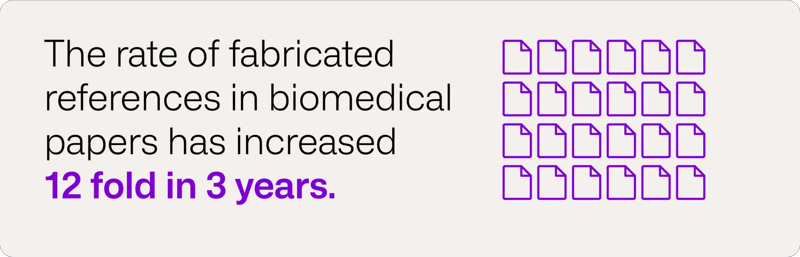
When a tool’s reasoning is unclear, it also creates more work for clinicians to validate answers. “Trust but verify” is a responsibility of even highly-skilled professionals. The danger is the answer you don’t know how to verify quickly, because you either can’t discern where it came from, or its quality is unclear. Large language models (LLMs) can generate plausible sounding but fictitious references. A recent reference-integrity audit spanning 2.5 million biomedical papers shows the rate of fabricated references has accelerated 12 fold in the last 3 years. 7 If it becomes necessary to leave the AI tool to verify the reference details, did you really gain efficiency?
Clinical validation of any AI assistant supporting care decisions is critical for patient safety, but it’s tricky in practice. Trust in clinical decision support tools is built over decades of real-world evaluation. When free AI tools make untraceable assumptions, it prevents evaluation of their credibility which is necessary for building trust.
System humility reduces risk
Students in any clinical discipline quickly learn not to presume to know the answer. It’s a highly necessary trait when patient outcomes are at stake. Being compelled to answer at all cost is dangerous in clinical scenarios.
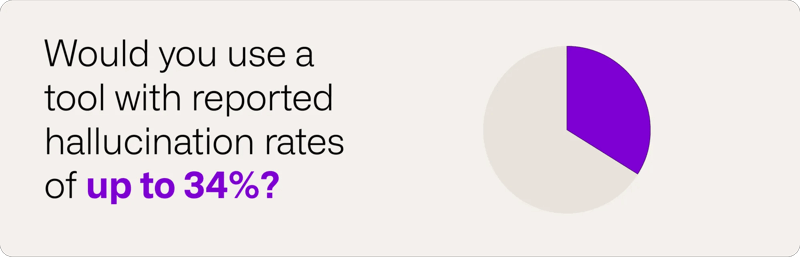
General purpose LLMs are designed to provide a response and are known to hallucinate and provide confident answers despite a lack of credible source material. This is even more so the case with free tools that are trying to prove their usefulness and grow their user base. And there are consequences to overconfidence. Hallucination rates of up to 34% were reported in a 2026 study of nine general-purpose LLMs.6
Hallucinations become especially dangerous when they sound plausible and convincing. As Joshua Hickey, Principal Technical Product Manager at Mayo Clinic, recently noted in his blog, “Explicit admissions of insufficient information increase trust more than confident but unsupported answers.”8
“Explicit admissions of insufficient information increase trust more than confident but unsupported answers.”
- Joshua Hickey, Principal Technical Product Manager at Mayo Clinic
Systems built for clinical care must have guardrails clearly defined and communicate when a query exceeds their capabilities. When this “system humility” is lacking, it’s a key indicator of risk. Safer systems build in uncertainty signaling, refusal patterns for unsafe queries, and escalation to validated references.
The hidden legal and regulatory costs
The financial and reputational risks of error are substantial. If an unvetted, free AI tool is used in clinical care and results in an error, the responsibility (legal, ethical, and professional) could fall on the clinician and the institution. This can bring new regulatory scrutiny, malpractice exposure, and potential loss of licensure.
It’s also important to question how these tools manage sensitive clinical data. Can you be sure data entered into a free tool is protected and not monetized? Data security and privacy should be non-negotiable, and transparency about data use is crucial for trust.
The regulatory landscape adds another layer of risk. Notably, a free AI-powered medical tool was recently withdrawn from the European Union and United Kingdom, citing the EU Artificial Intelligence Act.9 The FDA also continues to monitor these tools. This regulatory oversight is not a barrier; it’s a necessary safeguard.
High-risk tasks for free clinical AI tools
Free AI tools do have their place. They can facilitate access to information and assist with low-stakes administrative tasks or general queries. But for high-risk clinical interventions, they are not the right solution. They should not be used for:
- Medication dosing recommendations, especially for narrow therapeutic index drugs, in patients with renal or hepatic impairment, or in pediatric, neonatal or pregnant patients
- Drug interaction and contraindication screening and management in lieu of clinically validated systems
- Independent diagnostic decision-making, differential ranking or triage guidance based on patient-specific details
- Summarizing or interpreting patient charts, clinical notes, labs, or imaging reports containing identifiable data outside of secure systems
- Generating final treatment plans or clinical documentation without verification
The bottom line: Is it worth the risk?
Free AI tools serve a purpose. They are useful for low-stakes tasks; helping to draft administrative emails or format lists. But they fall short for decisions where patient safety, privacy, and professional accountability are at risk.
For AI tools in clinical practice, trust is critical, and safety-by-default is the standard. Clinicians need vetted tools that support informed decisions based on verifiable evidence.
Can your free AI tool deliver that confidence?
Read more about AI adoption in clinical practice.
Related Articles

The knowledge layer imperative: Why MCP in healthcare demands a higher standard
Clinical AI is only as good as what it knows. Discover why the model context...

Revolutionizing healthcare: The power of artificial intelligence in clinical workflows
Artificial intelligence (AI) is transforming workflows across industries,...

Conversational AI in healthcare: Innovation in action
How we search for information in healthcare has come a long way. As artificial...