

The story at a glance:
-
DAaaS solves the real bottleneck in healthcare analytics: data preparation
-
It delivers the greatest impact for organizations struggling with fragmented data, inconsistent definitions, and limited resources
-
DAaaS accelerates insight delivery and impact through standardized, governed, reusable analytics
-
Internal teams are freed to focus on higher‑value strategic initiatives instead of repetitive data wrangling
Most organizations that manage healthcare data and analytics think their analytics challenges come from tools or staffing, but the real constraint is upstream: data practitioners spend 80% of their time finding, cleaning, and organizing data, according to Pragmatic Institute. That leaves only a fraction of capacity for actual insight, modeling, or decision support.
Yet many analytics teams remain bogged down by the same challenges: fragmented source systems, inconsistent definitions, long development cycles, and highly skilled staff spending too much time on data preparation instead of insight generation.
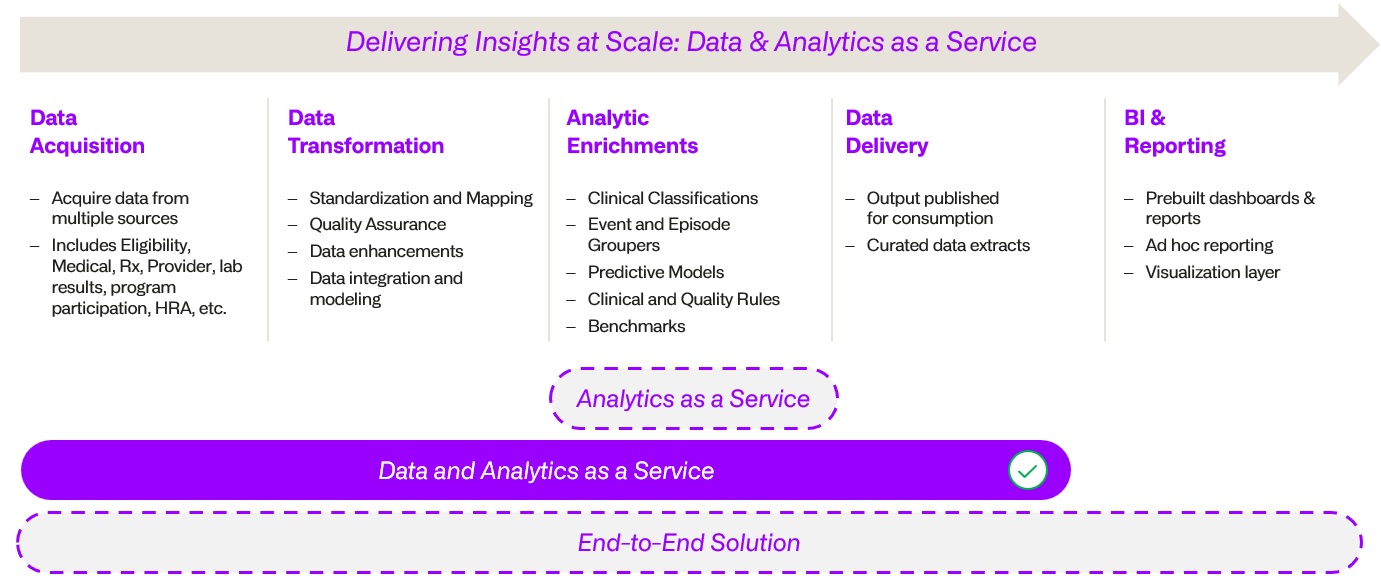
This is where Data and Analytics as a Service (DAaaS) is gaining traction—not as a replacement for internal analytics or technology platforms, but as a force multiplier. When done well, DAaaS provides a managed, repeatable foundation for data ingestion, enrichment, and analytic output that accelerates insight delivery, improves consistency, and frees teams to focus on higher value work.
Who should consider DAaaS?
DAaaS is not a one-size-fits all solution, and for organizations with the right resources and expertise, partnering with a vendor that can offer innovative analytic models (Analytics as a Service) to enhance in-house solutions can sufficiently fill gaps and meet business needs. Many analytics teams, however, struggle with streamlining siloed systems, maintaining data quality and consistency across business units, and balancing limited resources. This is where DAaaS is particularly compelling for organizations in the following spaces:
Health plans seeking operational analytics—not just reporting
Health plans face growing demands from regulators, providers, employers, and members. Additionally, they are managing multiple lines of business and increasingly complex quality, risk, and value-based programs. Many plans have a clear analytic vision but struggle with execution due to data silos, governance challenges, and limited engineering capacity.
DAaaS can help plans move from analytics as a series of bespoke projects to analytics as an enterprise utility—where trusted, consistent insight is delivered across care management, provider engagement, account management, and executive leadership.
Consulting houses scaling analytics delivery
Consulting firms supporting multiple clients often face tension between speed and customization. DAaaS enables consultants to standardize the hardest and least differentiating work—data pipelines, measure logic, enrichment routines—while preserving flexibility for client specific strategy and advisory services. The result is faster time-to-value and more consultant time spent on insight, storytelling, and decision support rather than data wrangling.
Technology companies dependent on analytics-ready data
For healthcare tech vendors, product success often hinges on the availability of clean, consistent, enriched data. DAaaS can act as the connective tissue between raw payer data and analytic or engagement tools. This helps reduce implementation friction, improve adoption, and ensure that applications are powered by defensible, repeatable analytic logic.
The core value of DAaaS
At its best, DAaaS delivers value in four reinforcing ways: speed, trust, reuse, and focus.
From data to decision
In healthcare, insight delivered too late is often insight wasted. DAaaS shortens the path from raw data to actionable intelligence by establishing automated ingestion, normalization, and refresh cycles aligned to operational needs. This enables faster decision loops—whether identifying care gaps, monitoring quality performance, or supporting employer and provider conversations.
Speed is not just about dashboards refreshing more often. It’s about reducing the lag between a question being asked and an answer being delivered to someone who can act on it.
Proven data management and governance
Most organizations don’t lack data—they lack agreement. DAaaS emphasizes standardized definitions, consistent transformations, and clear documentation so that teams across the enterprise operate from a shared source of truth. Chronic condition definitions, attribution logic, and measure calculations are aligned once and reused many times.
This consistency is especially critical in payer environments, where misaligned definitions can undermine trust, slow adoption, and derail performance improvement efforts.
Analytic accelerators that teams can build upon
A powerful DAaaS model goes beyond curated data to include analytic accelerators—prebuilt outputs that reflect best practice methodologies and can be extended over time. These often include:
-
Longitudinal disease and condition indicators that support population segmentation
-
Evidence-based measure results and gap logic for quality improvement
-
Predictive and stratification models powered by AI
Think of these accelerators as a robust baseline that internal teams can enhance, refine, and adapt as strategies evolve. Instead of rebuilding the same logic repeatedly, teams can focus on improving interventions, workflows, and outcomes.
Freeing staff for innovation and consultative work
One of the most underappreciated benefits of DAaaS is what it removes from internal teams’ workloads. By shifting ingestion, reconciliation, and baseline analytics into a managed service, organizations allow analysts and data scientists to spend more time on:
-
Designing programs and interventions
-
Partnering with clinical, network, and employer stakeholders
-
Experimenting with new models and hypotheses
-
Translating analytics into operational change
This shift is often where the true ROI of DAaaS is realized.
Getting the right insights into the right hands
Analytics only creates value when it reaches the people who can act on it. DAaaS works best when paired with a deliberate distribution strategy, which ensures that insights are delivered in forms that match different users’ needs:
-
Care managers need member level insights embedded in workflows
-
Providers need performance visibility tied to actionable measures
-
Account teams need population level narratives they can explain to employers
-
Executives need concise, consistent performance views
DAaaS enables this by publishing trusted analytic outputs once and allowing them to be consumed in many ways, without redefining the logic each time.
Case Study: How Blue Cross and Blue Shield of Alabama transformed data into action
Key considerations before adopting DAaaS
DAaaS is an operating model, not a shortcut. Organizations considering it should address several practical questions upfront.
Define the service clearly
What data products, analytic outputs, and refresh cadences are included? Which insights require near real-time updates versus standard cycles? Successful DAaaS programs are treated like products—with roadmaps, documentation, and release discipline.
Demand transparency and explainability
Analytics used for quality performance, provider engagement, or member outreach must be understandable and defensible. DAaaS should include clear documentation and versioning to avoid “black box” concerns and build trust across stakeholders.
Plan for integration, not isolation
DAaaS should feed existing workflows and platforms and not create another silo. Integration with care management tools, provider analytics, account reporting, and enterprise data environments is essential to realizing full value.
Measure outcomes, not just outputs
Beyond technical metrics, organizations should track:
-
Reduced time spent on data preparation
-
Faster time to insight for key use cases
-
Increased adoption across teams
-
Measurable improvements in targeted performance areas
DAaaS and analytic platforms: why “both” often wins
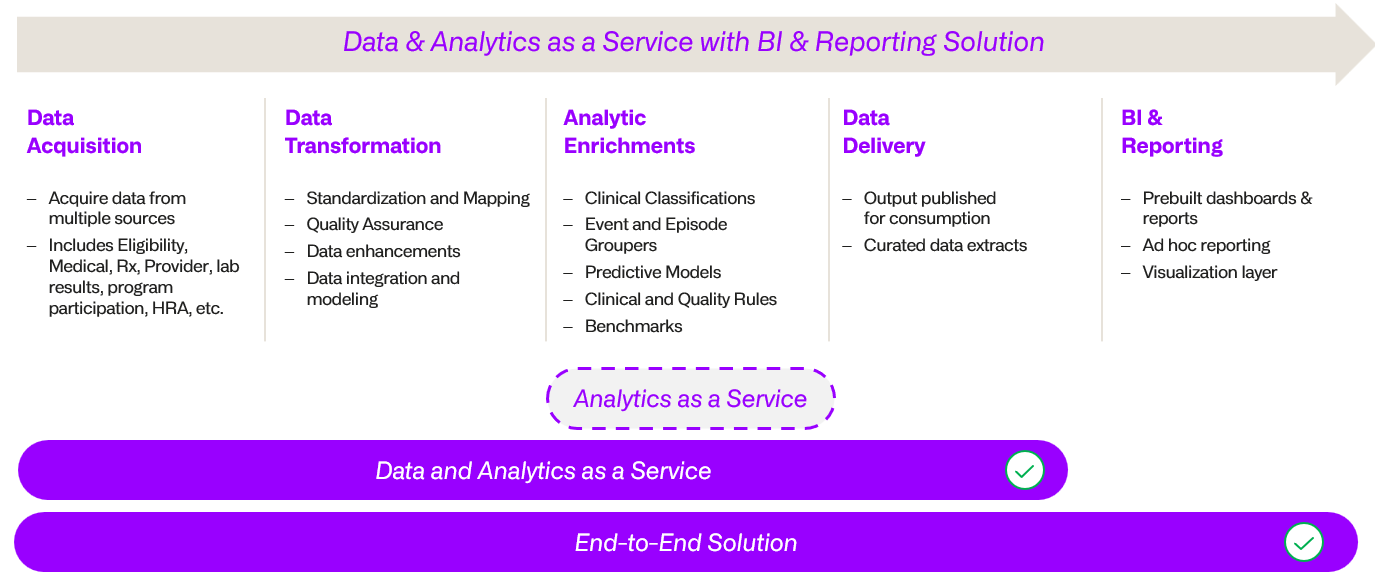
A common misconception is that organizations must choose between DAaaS and analytics platforms. In reality, many of the most effective strategies intentionally use both.
DAaaS provides curated data products, enriched measures, and analytic outputs that power advanced analytics and data science work. At the same time, executives, employer groups, and business users often prefer predefined, easy to digest dashboards that answer common questions quickly.
In this model:
-
DAaaS feeds analysts, data scientists, and downstream tools
-
Dashboards and applications present insights in role specific, intuitive ways
The result is a flexible ecosystem where innovation and usability coexist.
DAaaS as a force multiplier
DAaaS is not about outsourcing insight or giving up control. It is about recognizing that trusted, reusable analytics foundations should be delivered with the same rigor as other enterprise services.
For health plans, DAaaS can mean faster decisions and more consistent performance management. For consulting firms, it enables scale without sacrificing quality. For technology companies, it reduces friction and strengthens outcomes.
Ready to learn what DAaaS can do for your organization? Connect with Truven today.
Related Articles

Niche vs. enterprise analytics: Choosing the right path for healthcare success
Healthcare organizations are awash in data—from clinical records to operational...

What RxDC data reveals about prescription drug rebates and employer health plan costs
Prescription drug rebates have played an important role for some time in how...

The rising cost of healthcare: Predicting high-cost claimants with AI-driven insights
For the fourth year in a row, commercial payers are bracing for continued increases...