

Artificial intelligence is quickly becoming a priority across health and human services, with agencies exploring opportunities to improve service delivery, support staff, and modernize operations. Yet many leaders face the same challenge: knowing where to begin.
The difficulty is not finding potential AI applications. It is determining which opportunities are worth pursuing, how they align with agency priorities, and what governance considerations are required along the way. In human services, where privacy, accountability, and public trust are essential, agencies need a practical way to move from AI interest to AI action.
To help address that challenge, we developed a framework that helps agencies identify, prioritize, and implement AI use cases in a structured and responsible way. Rather than starting with a technology or vendor, the framework starts with the business problem and guides organizations through the key decisions needed to move from exploration to adoption.
How can HHS agencies move from AI interest to AI adoption?
The framework provides an eight-step process that helps agencies move from identifying opportunities to implementing and governing AI initiatives responsibly.
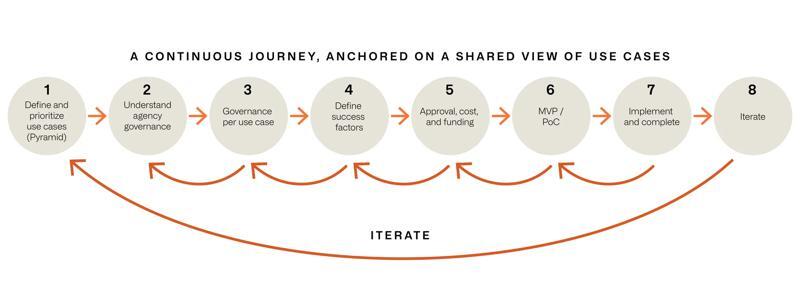
- Identify and prioritize use cases: Begin by identifying potential AI opportunities across delivery and engineering, caseworker-facing, and citizen-facing use cases, then prioritize those that align with agency goals and readiness.
- Review governance requirements: Assess privacy, security, legal, policy, and operational considerations to understand the controls and oversight needed for each use case.
- Determine the right deployment model: Evaluate how the solution should be deployed based on factors such as data sensitivity, risk, and organizational requirements.
- Define success measures: Establish clear objectives, expected outcomes, and metrics so success can be measured from the outset.
- Create the business case: Develop a business case that evaluates costs, benefits, risks, and the expected value of the initiative.
- Build a proof of concept: Test assumptions, validate feasibility, and demonstrate potential value through a focused pilot or proof of concept.
- Implement and operationalize: Transition successful initiatives into production with appropriate governance, monitoring, and support processes.
- Continuously improve and expand: Measure results, refine capabilities, and identify new opportunities as AI technologies and agency needs evolve.
Organizations that take a structured approach to AI adoption are better positioned to scale successful initiatives, avoid common pitfalls, and build the foundation for long-term innovation.
Download the full guide, Where to Start with AI in Health and Human Services, for a deeper look at the framework, practical use case examples, governance considerations, deployment approaches, and recommendations for responsible AI adoption.
Related Articles

See more. Do more. Faster: Cúram Action View is now generally available
Health and human services agencies are under increasing pressure to do more with...

A human-first vision for AI in child welfare
Child welfare has always been a field defined by its humanity and the compassion,...

Cúram by Merative recognized as a Major Player in IDC MarketScape: Worldwide Software Platforms for National Civilian Government AI-Enabled Case Management 2026 Vendor Assessment
We are proud to share that Cúram by Merative has been positioned as a Major Player...