

Prescription drug rebates have played an important role for some time in how pharmacy benefits are priced, managed, and evaluated. But for many employers and plan sponsors, rebate data has remained difficult to access in a way that supports plan-specific decision-making. Without a clear view into net drug costs, organizations may struggle to understand true pharmacy spend, evaluate pharmacy benefit management (PBM) performance, or identify opportunities to improve formulary and benefit design.
For employers and plan sponsors, the value of RxDC data goes beyond meeting a regulatory requirement. When rebate information is incorporated into analytics and reporting workflows, it can help reveal a more accurate picture of net drug spend, highlight savings opportunities, and support more informed conversations with PBMs, third-party administrators (TPAs), consultants, and internal stakeholders.
What is the Prescription Drug Data Collection (RxDC) program?
The Federal government has long recognized prescription drugs are a significant cost driver for health plans, making the collection of this data essential for analyzing trends and promoting transparency in the healthcare market. Historically, however, data on net prices after rebates has often been difficult for employers and plan sponsors to access in a plan-specific and actionable format. This makes certain insights, such as the price comparison of competing drug products or the efficiency of a drug formulary, difficult - if not impossible - to understand.
The Prescription Drug Data Collection (RxDC) program, established under the Consolidated Appropriations Act of 2021, attempts to address this limitation. It mandates annual reporting by group health plans and issuers on premiums, enrollment, medical costs, prescription drug spending, and rebates.
Employers and plans are ultimately accountable for RxDC reporting compliance but have several options for submission offering varying degrees of transparency. Traditionally, most plan sponsors, especially employers, have relied on insurance carriers and PBMs to handle submissions. These entities typically report aggregated data across their books of business, which satisfies regulatory requirements but offers limited transparency for individual payers.
As the mandate becomes more familiar, a shift is emerging: more Plan Sponsors are choosing to submit directly to CMS or work through a TPA. Direct submission provides greater visibility and control over plan-specific data, offering clearer insight into how rebates impact overall pharmacy spend, cost driver identification, PBM performance, and savings opportunities.
How greater transparency can improve cost management for employer-sponsored plans
RxDC reporting has opened the door to a new level of visibility for employer-sponsored plans. These reports include not only total rebate amounts but also detailed breakdowns by drug class and product— data that can transform how payers evaluate and manage prescription drug costs.
A RAND analysis of the first two years of RxDC reporting found that rebates accounted for 20–22% of gross drug spending in employer-sponsored plans—significantly lower than 31% in Medicare Part D and 53% in Medicaid. This gap highlights an opportunity for employer-sponsored plans to improve cost management through greater transparency.
Many plan sponsors are beginning to integrate these rebate amounts into their analytics, creating opportunities for more accurate reporting and insight-driven strategies. Establishing expectations with PBMs to provide this information is an important first step toward having rebate details flow directly into your claims feed. With this data incorporated into your analytics tools, employers and plans gain a clearer picture of net drug spend and can make more informed choices about coverage and formulary design.
By incorporating rebate data into drug cost reporting, payers are seeing a very different picture of their annual spend—one that reflects true net costs rather than gross figures.
Below is an illustrative chart, based on actual reported trends, showing how rebate adjustments can dramatically alter drug spend analyses—providing plan sponsors with a stronger foundation for planning and cost optimization.
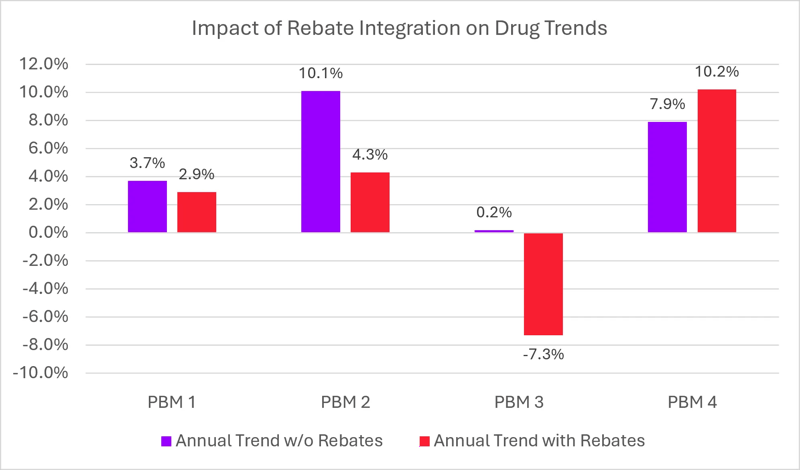
By incorporating rebate information, the drug cost and trend picture can change, and in some cases dramatically. The trends of PBM 1-3 in the above are all lower after incorporating rebated with PBM 3 demonstrating a negative rather than stable trend. PBM 4 demonstrates greater rebate impact in the prior year.
Ensuring your PBMs provide complete rebate data affords you the ability to better evaluate and benchmark your plan’s performance.
Turning compliance into insight: Why sponsors are choosing expert support
Partnering with an experienced reporting entity offers more than just meeting RxDC requirements - it delivers clarity, control, and confidence. By working with a trusted TPA, plan sponsors gain:
-
Direct visibility into the financials submitted on their behalf, including prescription drug rebate data.
-
Confidence in compliance, backed by proven experience navigating CMS programs and regulatory requirements.
-
Advanced reporting and analytics, leveraging tools like Health Insights to integrate RxDC data for deeper insights.
The evolving transparency landscape
While RxDC reporting was established to improve transparency around prescription drug costs, rebates, and healthcare spending, the broader pharmacy benefits landscape continues to evolve. Recent federal and state policy initiatives have increased focus on pharmacy benefit manager (PBM) transparency, including reporting on rebates, spread pricing, PBM compensation, and overall pharmacy benefit performance.
Although many of the newest PBM transparency requirements are not expected to take effect for several years, the direction is clear: employers, health plans, and regulators are seeking greater visibility into the factors that drive prescription drug costs and financial outcomes.
For plan sponsors, this reinforces the value of establishing strong data collection, reporting, and analytics processes today. Organizations that leverage RxDC data beyond compliance can gain a better understanding of net drug costs, rebate performance, and pharmacy spending trends while building a foundation to support future transparency and reporting initiatives as they emerge.
Planning ahead with Truven for RxDC reports
Relying solely on aggregated submissions limits transparency. Partnering with an experienced reporting entity like Truven empowers employers and plan sponsors with plan-specific data - unlocking smarter decisions and stronger compliance.
Deeper insights start with setting expectations with your PBM to furnish rebate data directly to your reporting partner. This unlocks the full value of your analytics tools and positions your plan for data-driven strategies that improve cost management and coverage design. Supporting compliance through a TPA can help facilitate data integration of rebate information, strengthen compliance, and support advanced analytics.
Truven has collaborated with multiple plan sponsors to prepare and submit RxDC reports. To learn more, get in touch.
Related Articles

Data & Analytics as a Service (DAaaS) in healthcare: Speed, scale, and sustainable insight
The story at a glance:

Niche vs. enterprise analytics: Choosing the right path for healthcare success
Healthcare organizations are awash in data—from clinical records to operational...

The rising cost of healthcare: Predicting high-cost claimants with AI-driven insights
For the fourth year in a row, commercial payers are bracing for continued increases...